This project is a submission for the 2017 AIA COTE Student Design Competition. Find out more at https://www.aia.org/design-excellence/awards/cote-top-ten-student-competition.
This project was completed in collaboration with Brittany Arnold, AIA.
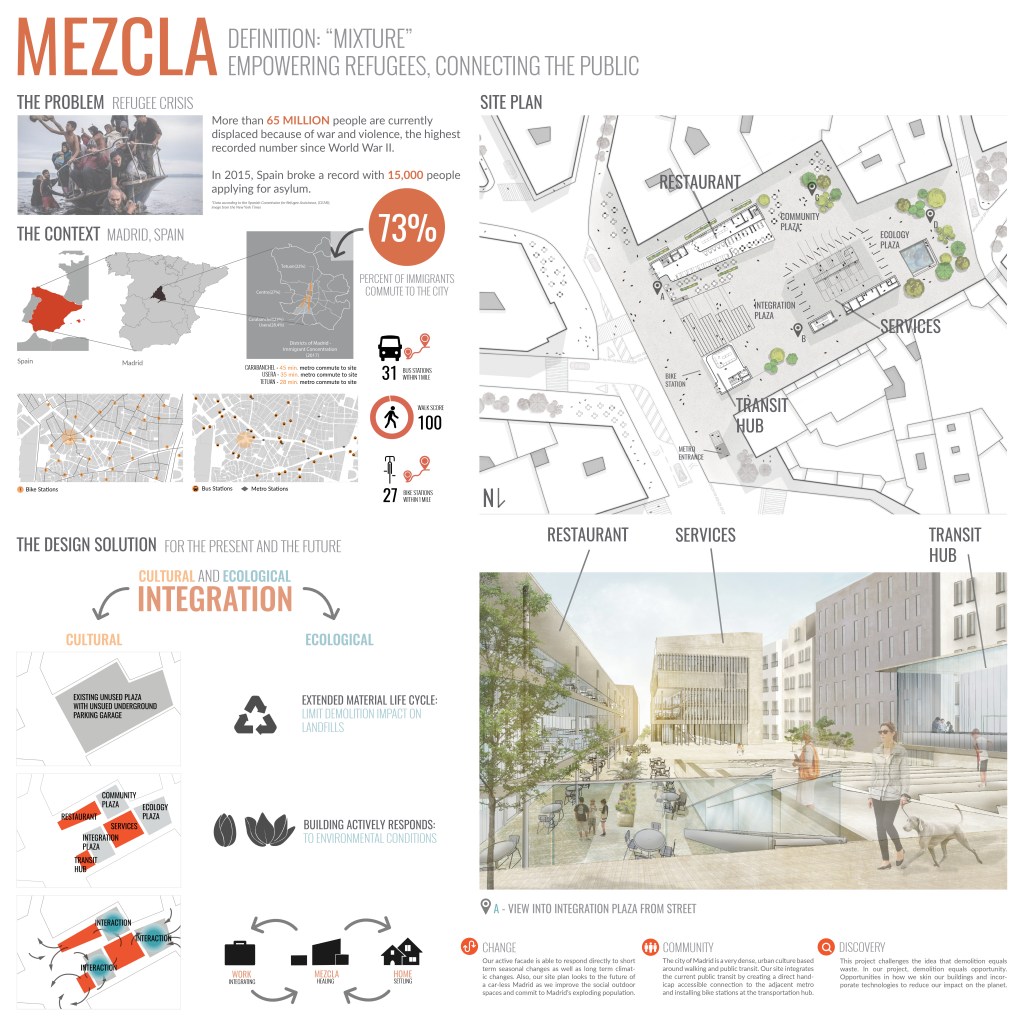
There is a humanitarian crisis in the middle east. People have been fleeing war to start a new life in Europe. This has created hostile tensions among most European citizens. The architectural response to this problem thus far is to isolate refugees from the rest of the European population. Camps, slums, and isolated neighborhoods are the current urban response to the problem. People are always sacred of what they cannot see and cannot relate. Though, Spain remains a very receptive culture to immigrants despite tensions elsewhere. They have had a long history with accepting asylum seekers from Africa and South America. Our project aims to create a Center for Integration in the heart of Madrid, among the population. A center of refuge in the most vibrant sector of Madrid, for those who need it most.
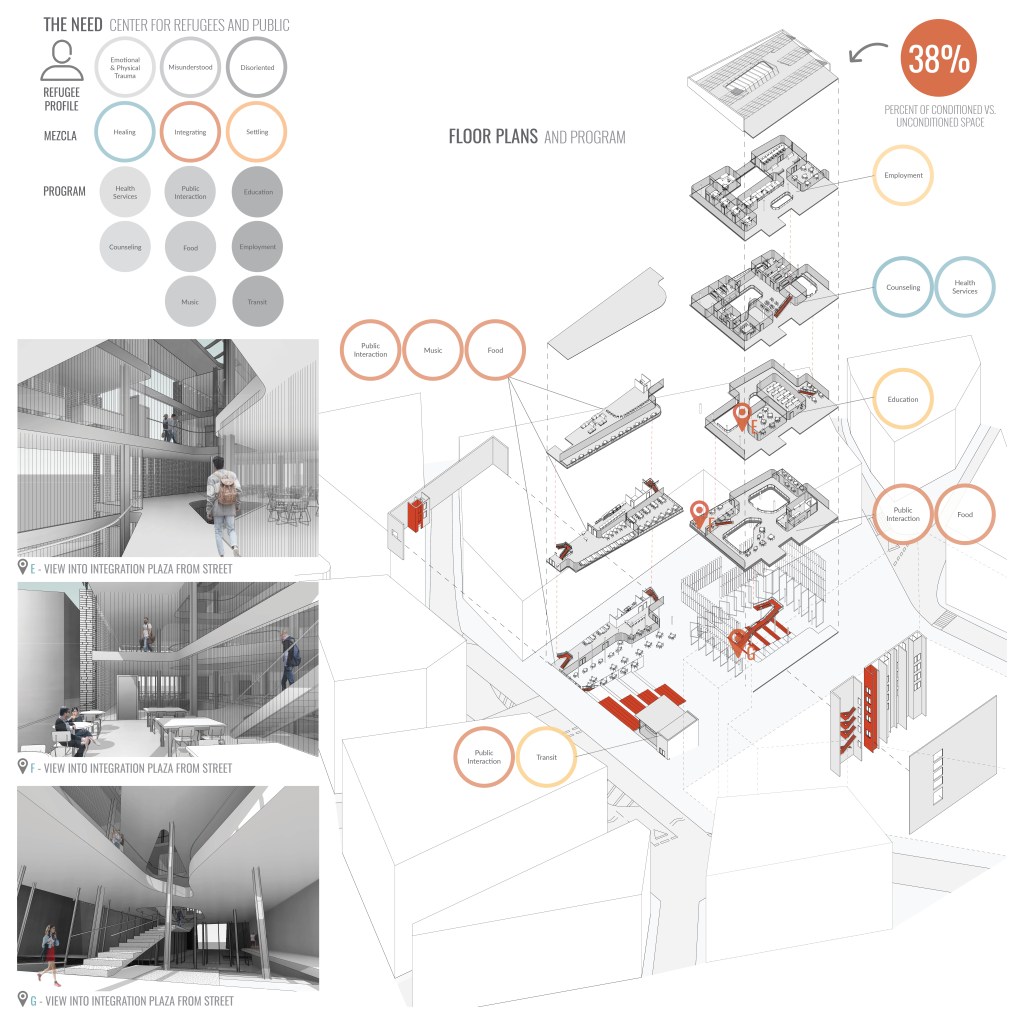
We have designed MEZCLA (spanish for “Mixture”), a space to empower the refugees and connect them to the public. The typical refugee is misunderstood, has endured emotional and physical trauma, and is disoriented upon arrival in a foreign country. As a direct response to each of these issues, our project aims to HEAL, INTEGRATE, and SETTLE these refugees.
Our site is taking an abandoned, underground parking structure in downtown Madrid and carving into it and placing three separate but connected structures. Atop the parking garage is the Plaza de Santo Domingo, a large, unsuccessful urban space. We plan on dividing this large space into three small distinct outdoor plazas with our intervention. By reducing the size of the space to the human scale, each plaza will have a unique identity: the integration plaza, the community plaza, and the ecology plaza.
Public space and the culture of walking are extremely important to the average Madridian. Therefore, we lifted our services building above the plaza to continue the space beneath, through, up, and into the building. Every space in the building is open to the public. 80% of the year 72% of the building is filled with fresh air in a shaded, temperate, unconditioned environment that blurs the line between inside and out. The smell of plaza(s) will fill the building. Where necessary, pods of conditioned space are placed to provide classrooms, healthcare, and offices.
As for program, our buildings will be 1) a services building (24000 sqft) with job training, language classes, a health clinic, and office space. Connected to all three of our outdoor plazas, this building is the anchor of the site and the primary refuge for immigrants needing assistance. 2) A restaurant (7000 sqft) open to the public as an integration space. The outdoor balconies provide shaded areas to eat while overlooking the integration and community plazas. This program will also provide job opportunities for refugees. 3)Also a transportation hub (2000 sqft) linking the site to the adjacent metro station, bus stop, and bike station. Along with the restaurant and the services building, the hub forms the integration plaza, a place for gathering, eating, relaxing, and playing for everyone.
01 | DESIGN FOR INTEGRATION
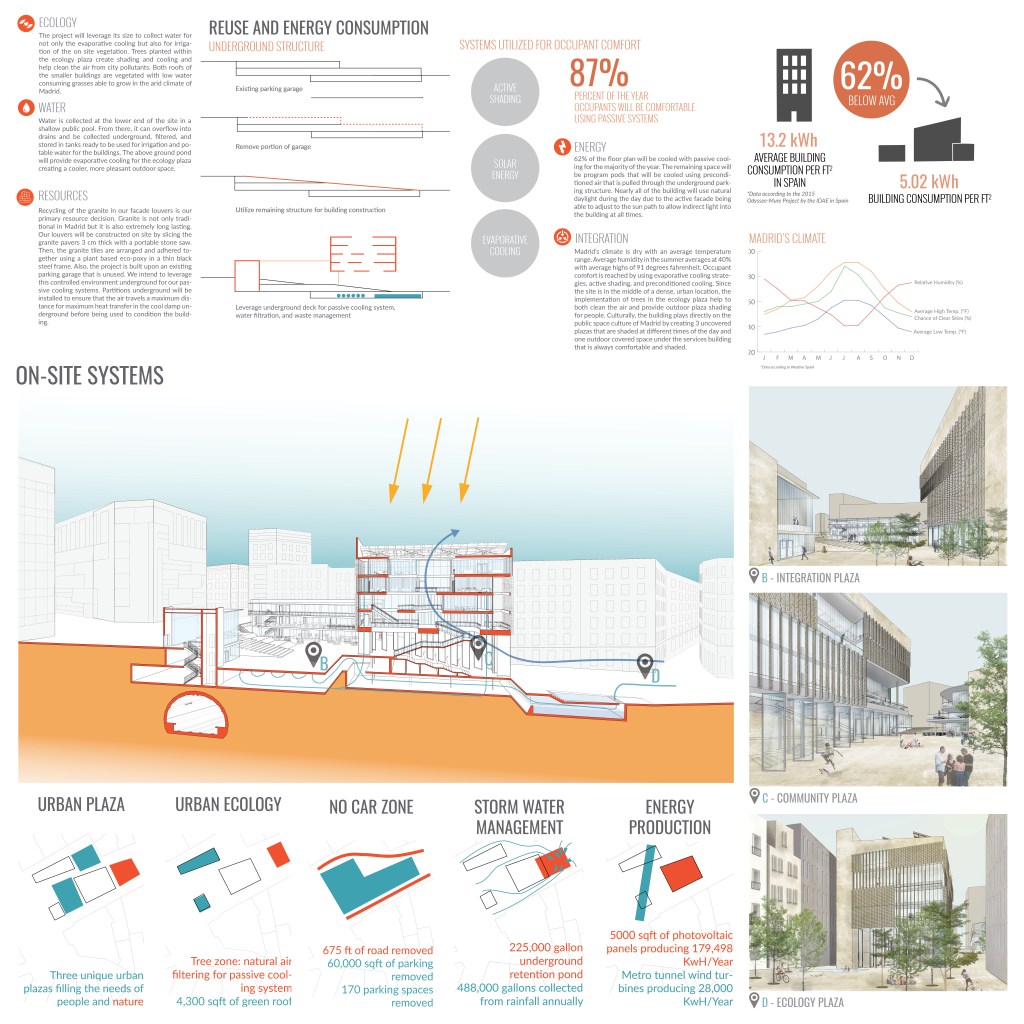
Madrid’s climate is dry with an average temperature range. Average humidity in the summer averages at 40% with average highs of 91 degrees fahrenheit. Occupant comfort is reached by using evaporative cooling strategies, active shading, and preconditioned cooling. Since the site is in the middle of a dense, urban location, the implementation of trees in the ecology plaza help to both clean the air and provide outdoor plaza shading for people. Culturally, the building plays directly on the public space culture of Madrid by creating 3 uncovered plazas that are shaded at different times of the day and one outdoor covered space under the services building that is always comfortable and shaded.
02 | DESIGN FOR COMMUNITY
The city of Madrid is a very dense, urban culture based around walking and public transit. Our site integrates the current public transit by creating a direct handicap accessible connection to the adjacent metro and installing bike stations at the transportation hub. The government of Madrid is committed to advancing this walking culture in the future by removing 66% of the roads and turning them over to pedestrians. Our plan removes all 170 parking spaces and 8100 square feet of roadway from the site. This is a direct contribution and investment into the long term urban plan for the city.
03 | DESIGN FOR ECOLOGY
The project will leverage its size to collect water for not only the evaporative cooling but also for irrigation of the on site vegetation. Trees planted within the ecology plaza create shading and cooling and help clean the air from city pollutants. Both roofs of the smaller buildings are vegetated with low water consuming grasses able to grow in the arid climate of Madrid.
04 | DESIGN FOR WATER
Water is collected at the lower end of the site in a shallow public pool. From there, it can overflow into drains and be collected underground, filtered, and stored in tanks ready to be used for irrigation and potable water for the buildings. This system has the capacity to handle 100% and more of the stormwater. The above ground pond will provide evaporative cooling for the ecology plaza creating a cooler, more pleasant outdoor space.
05 | DESIGN FOR ECONOMY
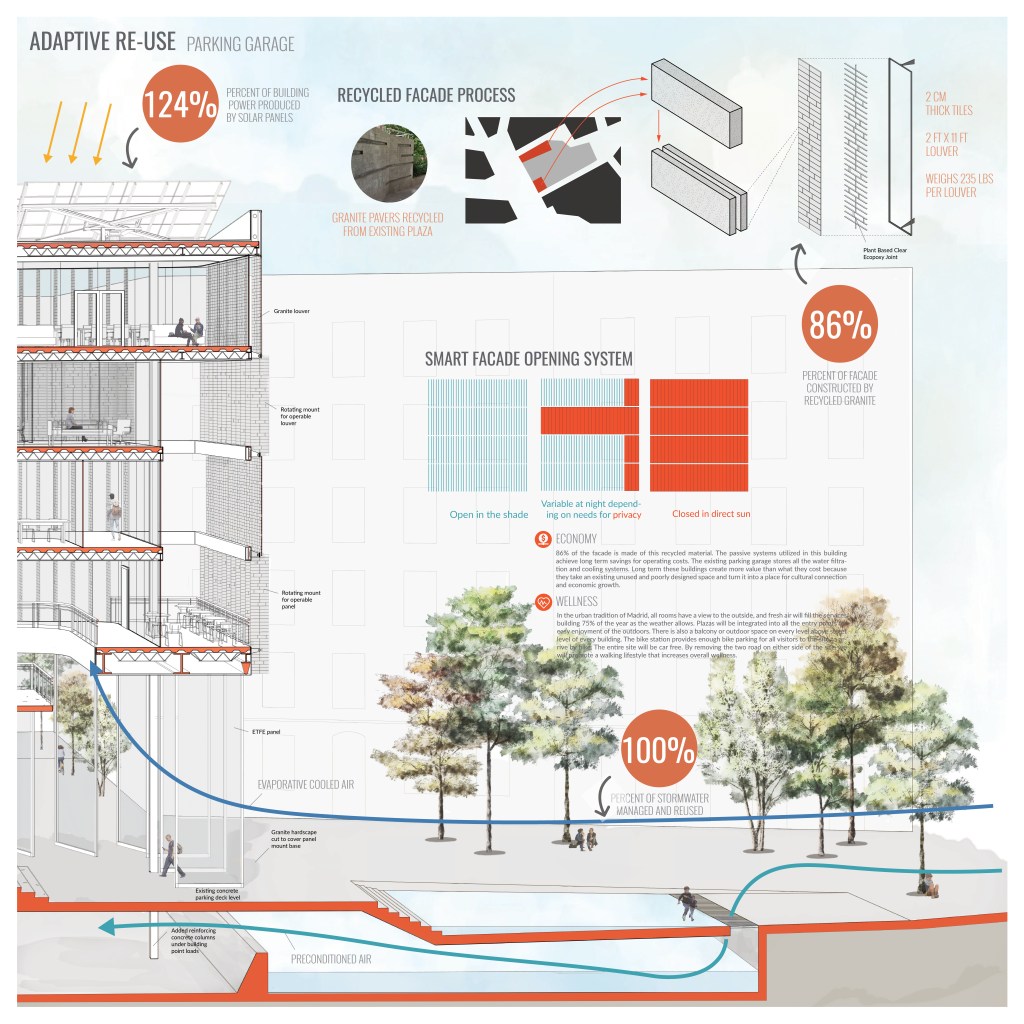
The granite material used on the building facade has been taken from the existing hardscape in the area being demolished for the transportation hub and the restaurant. 86% of the facade is made of this recycled material. The passive systems utilized in this building achieve long term savings for operating costs. The existing parking garage stores all the water filtration and cooling systems. Long term these buildings create more value than what they cost because they take an existing unused and poorly designed space and turn it into a place for cultural connection and economic growth.
06 | DESIGN FOR ENERGY
62% of the floor plan will be cooled with passive cooling for the majority of the year. The remaining space will be program pods that will be cooled using preconditioned air that is pulled through the underground parking structure. Nearly all of the building will use natural daylight during the day due to the active facade being able to adjust to the sun path to allow indirect light into the building at all times. Additionally, the roof of the services building will be covered in 5000 square feet of photovoltaic panels producing enough energy for 16 average U.S. homes. Also, wind turbines installed in the metro directly below the site could produce an additional 3 homes worth of power.
07 | DESIGN FOR WELLNESS
In the urban tradition of Madrid, all rooms have a view to the outside, and fresh air will fill the services building 75% of the year as the weather allows. Plazas will be integrated into all the entry points for easy enjoyment of the outdoors. There is also a balcony or outdoor space on every level above street level of every building. The bike station provides enough bike parking for all visitors to the site to arrive by bike. The entire site will be car free. By removing the two road on either side of the site, we will promote a walking lifestyle that increases overall wellness.
08 | DESIGN FOR RESOURCES
Recycling of the granite in our facade louvers is our primary resource decision. Granite is not only traditional in Madrid but it is also extremely long lasting. Our louvers will be constructed on site by slicing the granite pavers 3 cm thick with a portable stone saw. Then, the granite tiles are arranged and adhered together using a plant based eco-poxy in a thin black steel frame. Also, the project is built upon an existing parking garage that is unused. We intend to leverage this controlled environment underground for our passive cooling systems. Partitions underground will be installed to ensure that the air travels a maximum distance for maximum heat transfer in the cool damp underground before being used to condition the building.
09 | DESIGN FOR CHANGE
Our active facade is able to respond directly to short term seasonal changes as well as long term climatic changes. By using this active solar tracking technology, our facade can respond to the sun angle, outdoor temperature, and climatic conditions in any situation to provide ideal comfort for the inside. Also, our site plan looks to the future of a car-less Madrid as we improve the social outdoor spaces and commit to Madrid’s exploding population.
10 | DESIGN FOR DISCOVERY
The biggest design lesson from this project is how to integrate a sustainable building in an urban environment while adding to, not distracting from, the context of the urban condition.
Though, in terms of technological innovation for the future of resource management, we are taking existing stone cutting technologies and combining them with active facade treatments. This project challenges the idea that demolition equals waste. In our project, demolition equals opportunity. Opportunities in how we skin our buildings and incorporate technologies to reduce our impact on the planet.
 BERT NASH, AIA