DEarchify is a series that explores the interesting and peculiar connections between architecture, design, and everyday life. The series admittedly makes some wild stretches.
Sailing is an intriguing sport because it carries connotations of luxury and old-world charm. What comes to mind is a scene of affluent people lounging on boats, sipping champagne while the wind effortlessly carries them across the water—enjoying leisure time unavailable to the average working person. It truly is a luxury to travel slowly. But what many don’t realize is that there’s a disconnect between the sport of sailing and the luxury of sailing. So while this series tries to connect architecture with daily life, I’ll admit—this might be the stretch of all stretches.
I participate in what’s called one-design sailboat racing. The premise is simple: everyone shows up with the exact same boat. Using the same equipment levels the playing field and allows you to directly test your skill against another sailor. While the sport can be either expensive or relatively affordable, I race in a modest fleet at a local inland lake club. Compared to most boats, mine is inexpensive.

Because of the one-design nature of the sport—and of sailing itself—the difference between a winning sailor and a losing one comes down to technique, strategy, and tactics. So in this post, as I attempt to connect sailing and architecture, I’m not going to focus on the boat’s design, the elegant curve of its hull, or the beauty of sails on the horizon. I’m going to talk about reach ranges.
To develop good technique as a sailor, you have to understand the geometry and layout of your boat. You need to operate all the lines and the helm efficiently, often while coordinating with a crew. We spend a lot of time discussing where to sit, how to move, and how to position ourselves to access everything smoothly. Every time I sit in my boat and reach for the helm or control lines, I think about something fundamental to architectural practice: standard accessibility details.
In a set of construction drawings, we always include early pages—usually the second or third—that outline accessibility standards. These aren’t decorative; they’re legal, ethical, and deeply human. They define the maximum and minimum reach distances for people using wheelchairs: how high a paper towel dispenser can be, how far someone should have to reach for a faucet, how much clearance a door requires. These diagrams are precise and standardized, but they represent something larger: the idea that space should respond to people, not the other way around. They remind us that architecture isn’t just about form or beauty—it’s about function, dignity, and inclusion.
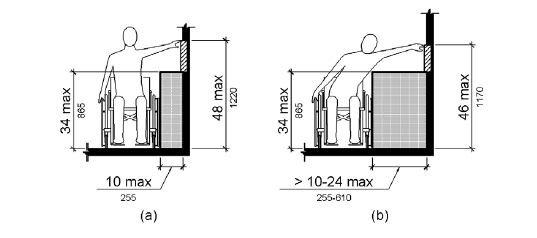
Just like a sailor tailors their movements to the physical reality of the boat, architects must design spaces that respond to the physical realities of the people who use them. When I adjust my weight in the cockpit to make a tack smoother, I’m not just trimming for speed—I’m responding to how the space performs under pressure. And when I draw a bathroom layout to meet ADA standards, I’m not just checking boxes—I’m anticipating how someone might move, reach, and live inside the space. Both acts are quiet forms of empathy, expressed through design.
When we’re hired, we always emphasize to our clients that as licensed architects, we carry dual responsibilities—both to them, as owners, and to the public. We are charged with protecting the health, safety, and welfare of anyone who enters the buildings we design. As a member of the public, when you walk into a restaurant, a store, or an office, you unconsciously expect a certain level of design quality. You instinctively expect the floor to be level as you step inside. You assume the hallway will be wide enough to pass someone without brushing shoulders. You don’t consciously think about where the light switch is—but it’s always where your hand expects it to be. Door handles turn easily, sinks are within reach, and signage quietly guides you where you need to go. These things don’t feel designed—they just feel right. And that’s the quiet success of thoughtful architecture: when good design becomes invisible.
So—how does this relate to sailing?
In sailing, we shape the cockpit for performance, ensuring every control is within reach, every movement deliberate, every surface working in harmony with the body and the wind. In architecture, we do the same. We design for a kind of performance that rarely earns applause—one measured not in spectacle, but in seamlessness. It’s a choreography most people never see, yet feel in every effortless step, every intuitive reach, every silent cue.
That is the quiet grace of design—its force felt not in what it demands, but in what it allows. The wind moves the boat, but it is design that lets you hold the course.
 BERT NASH, AIA
Leave a comment